
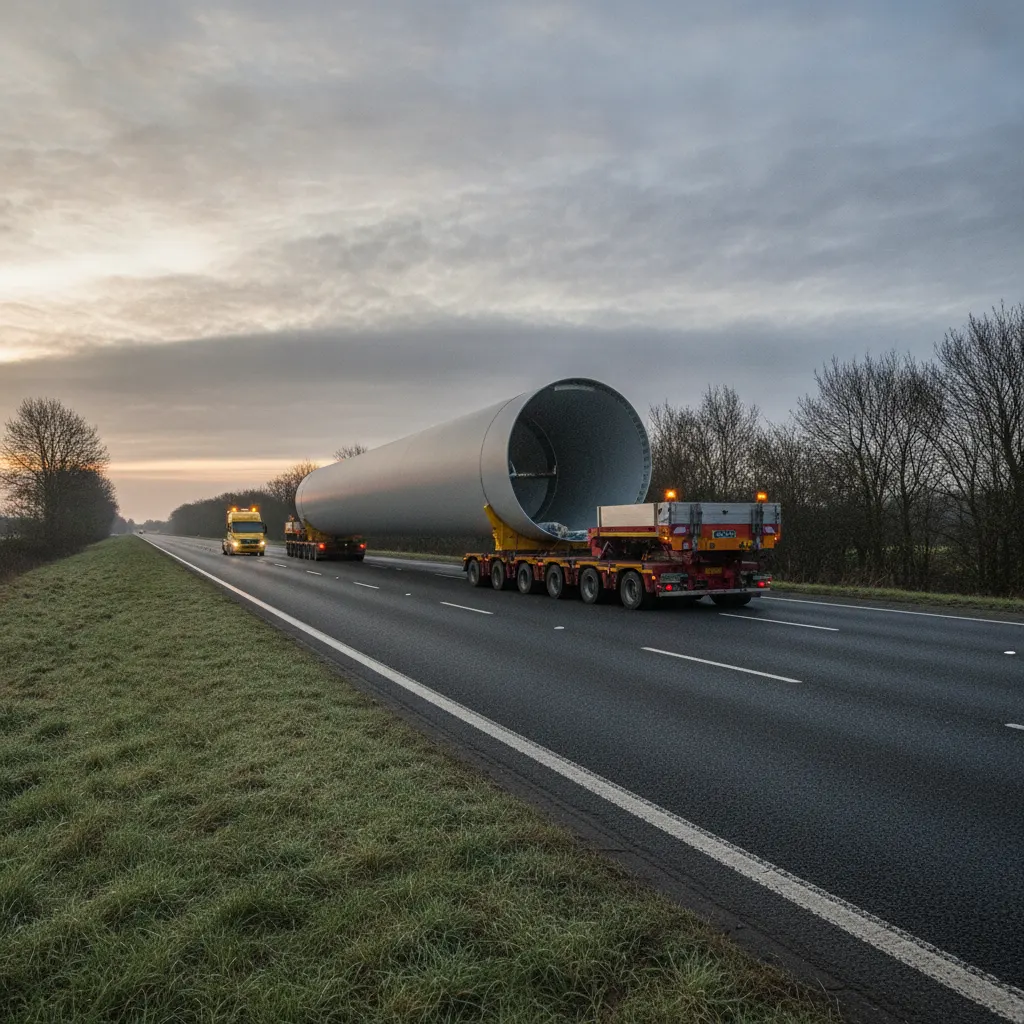
Most of the trucks on the road are operating within normal type approval limits — the standard weight and dimension rules that apply to any goods vehicle in ordinary commercial service. STGO moves are something else entirely. The Road Vehicles (Authorisation of Special Types) (General) Order 2003 — SI 2003/1998 — is what makes it legal to put 80,000kg on the road on a multi-axle trailer that's wider than a lane of traffic. But it comes with conditions. A lot of conditions.
I've done two shifts as an escort driver on abnormal load movements. One was a transformer from a power station in the East Midlands heading for a new substation near Peterborough. The other was a wind turbine tower base section going to the coast. The actual driving on both was slow, early-morning work on pre-cleared routes. The preparation that went into each — the route surveys, the bridge calculations, the highway authority notifications, the police liaison — was weeks of planning before anyone moved anything.
Here's how the STGO system works for drivers and operators who are coming to it fresh.
What STGO actually authorises
The Special Types General Order creates a framework for operating vehicles and loads that exceed normal Construction and Use regulations. If a vehicle or a combination is within type approval and normal C&U limits, it doesn't need STGO authorisation. The moment it exceeds those limits — in weight, width, length, or projection — STGO is what you operate under.
STGO doesn't give you a blank authorisation to move anything anywhere. It sets categories with specific limits, and movements must be planned and notified in accordance with the category that applies to the load. Exceeding the STGO limits for your category isn't just a paperwork issue — the vehicle isn't legally on the road.
The three STGO categories for Abnormal Indivisible Load Vehicles
For goods vehicles carrying abnormal indivisible loads (AILVs), there are three categories under Schedule 1 of SI 2003/1998. Each has different weight limits and different speed restrictions.
Category 1: covers loads up to approximately 50,000kg (higher with six or more axles; the exact limit depends on the axle configuration and the authorised weight formula). Speed limits under Category 1 are 60mph on motorways, 50mph on dual carriageways, and 40mph on other roads.
Category 2: covers loads up to 80,000kg. The speed limits drop significantly — 40mph on motorways, 35mph on dual carriageways, and 30mph on other roads. The axle weight calculations are also more prescriptive, with minimum axle requirements and individual axle weight limits.
Category 3: covers loads up to 150,000kg. The same speed limits as Category 2 apply — 40mph motorway, 35mph dual carriageway, 30mph other roads. For Category 3 loads, the planning and clearance requirements are more intensive, and police involvement is essentially certain.
The maximum width across all STGO categories is 6.1 metres. Loads wider than that fall outside even the STGO framework and require a Special Order from the Secretary of State — a separate process entirely, rarely used, usually involving abnormal indivisible loads that genuinely can't be split or reduced in width.
Maximum length for STGO AILV combinations is 30 metres. Again, exceeding this requires special authorisation.
What triggers police involvement
Police involvement in an abnormal load movement isn't automatic, but it kicks in at lower dimensions than most people expect.
Article 15 of SI 2003/1998 requires notification to the chief officer of police for each area the movement passes through when the load's overall width exceeds 3 metres. This is notification — telling the police the movement is happening — not a request for an escort. But it's the trigger for police contact, and what happens next depends on the load, the route, and the police force.
When width exceeds 3.5 metres, the load must also be accompanied by attendants — typically pilot/escort vehicles — positioned to warn other traffic. The specific number of attendants and their positioning depends on the width and route characteristics.
For loads approaching or exceeding the Category 3 weight thresholds, or for loads of unusual dimensions that present genuine traffic management challenges, the police will often require the movement to travel at specific times — typically at night or on a Sunday — with a police vehicle leading or following the convoy. The requirement for an actual police escort emerges from the notification and planning process rather than being automatically triggered by a single threshold.
In practice: for a load requiring Category 2 or Category 3 STGO authorisation, assume police will be involved in the planning. Contact the relevant police force early. Don't assume notification-only means the police won't have conditions to attach.
The ESDAL system and notification requirements
ESDAL2 — Electronic Self-Declaration for Abnormal Loads, version 2 — is the DVSA portal for submitting movement notifications to highway authorities and the police. It replaced a paper-based notification system and allows operators to submit movement details electronically, with the system distributing notifications to the relevant highway authorities along the route.
For standard STGO movements requiring notification, the 2-day notice rule applies: highway authorities must receive at least 2 clear days' notice (for Category 1 loads) before the movement, to allow them to check for any obstructions, roadworks, or conditions that affect the route. For heavier Category 2 and 3 loads, the advance notice requirement is typically longer — 5 days for Category 2 and up to 5 days for Category 3, though the exact requirements depend on the specific movement.
ESDAL routes the notification automatically to each highway authority the route passes through. The operator enters the route on the system, ESDAL calculates which authorities need to be notified, and those authorities can log any objections or conditions. It's not a rubber stamp — highway authorities can object to specific routes or require modifications, and those objections need to be resolved before the movement goes ahead.
The route survey — why it comes before everything else
Before any STGO movement of a significant load, a route survey needs to confirm that the proposed route is physically capable of taking the load. This isn't optional for Category 2 and 3 movements. The survey covers:
- Bridge capacity — every structure the route crosses needs to be checked against the load's gross weight and axle loadings. The Highways England (National Highways) bridge database and local authority records are part of this. Some bridges that appear on a map as crossing a route aren't shown as load-restricted until the survey checks them.
- Width clearances — overhead power lines, traffic signals, gantries, and overhanging structures need to be measured against the load dimensions.
- Turn radii — can the combination actually navigate every junction and roundabout on the route? Some loads require traffic signals to be temporarily removed or repositioned. Some require street furniture to come out.
- Road surface condition — for very heavy loads, the surface needs to be able to transmit the weight to the substrate without failure.
The route survey is usually done by specialist haulage planners with engineering expertise. For large power infrastructure or wind turbine components, the operator may commission the survey six to twelve weeks before the proposed movement date. The planning timeline for a significant abnormal load move is measured in months, not days.
Speed restrictions and the night-time window
Category 2 and 3 movements at 30-40mph on roads that normally carry 50-70mph traffic are inherently disruptive. Police conditions for these movements often specify time windows — midnight to 5am is common on motorway sections. Sunday mornings work for some A-road routes where traffic is lighter.
These windows mean the convoy might be travelling at 3am on a motorway that's otherwise quiet but not empty. Escort vehicles run ahead to clear the route, and the combination moves through. If something goes wrong en route — a tyre issue, a mechanical fault, a route obstruction that wasn't there on the survey — the convoy parks up and waits for resolution. You don't just pull over on the hard shoulder with a 100,000kg load and a 6-metre-wide trailer and carry on when you feel like it. Contingency planning is part of the movement plan.
What the driver actually needs to know
Drivers operating STGO vehicles need to be briefed on the specific movement plan for each journey. The plan should cover the route, the permitted times, the speed restrictions, the escort arrangements, the contact details for the escorting police officer, and what to do in the event of a problem on route. There's no generic "do it the way you usually do" for an abnormal load movement — each one is specific to the load, the route, and the conditions.
The driver holds a copy of the movement order in the cab. DVSA or police who stop the convoy will want to see it. The authorisation documents — proof of the STGO category, the ESDAL notification reference, any Special Orders — should be in the cab.
One more thing worth knowing: escort vehicle drivers on abnormal load movements aren't exempt from EU 561/2006 just because they're supporting the main load vehicle. Hours rules apply to escort drivers the same as any other goods vehicle driver. On a long movement that runs into the small hours, the escort driver's rest requirements need to be planned the same as the load driver's.
Is STGO work worth doing as a driver?
Pay rates on specialist haulage — both driving the load vehicle and escort work — are typically better than standard Class 1 tramping rates. The hours can be unsocial (3am starts on motorways are a regular feature), the pace is slow, and there's a lot of waiting involved in route clearances and police handovers. But if you're patient, methodical, and comfortable with very precise driving at low speeds on public roads in the early hours, it's a specialist niche with a skills shortage.
Escort drivers need a clean licence and a vehicle that's been through specific escort suitability checks. Most specialist haulage operators run structured training for escort work. It's not a case of turning up with a van and waving a flag — the positioning requirements, the communications protocol with the lead vehicle and police, and the specific actions on a route problem are all trained and practised.
The load vehicle itself is usually operated by the specialist haulage firm. They're typically Class 1 drivers with additional training on the vehicle type — multi-axle platform trailers, hydraulic neck trailers, and self-propelled modular transporters (SPMTs) all have specific operating characteristics. SPMT work is at the very specialist end — for very large and very slow loads where the trailer itself is motorised.
What the operator needs before an STGO movement can start
Checklist for operators planning a Category 2 or Category 3 movement:
- Confirm the STGO category that applies to the load weight and dimensions
- Commission a route survey if not done recently or if the route hasn't been used for this load type before
- Submit ESDAL2 notifications with the required advance notice period
- Notify the police in each area where width exceeds 3 metres
- Confirm escort and attendant requirements with police
- Agree movement time window with police
- Check bridge certificates for all structures on the route
- Ensure the driver and all escort drivers have the movement plan
- Confirm contingency plan for route problems
The 2-day notice minimum for Category 1 loads sounds like very short planning time because it is. In practice, STGO movements of any complexity are planned weeks in advance. The ESDAL notification is submitted as part of a completed plan, not as the first step in a process that's still being worked out.
If you're managing driver hours across a mixed fleet that includes specialist haulage or escort work, ShiftOwt tracks 561/WTD compliance automatically — £5.99/mo for drivers, fleet pricing on request.