
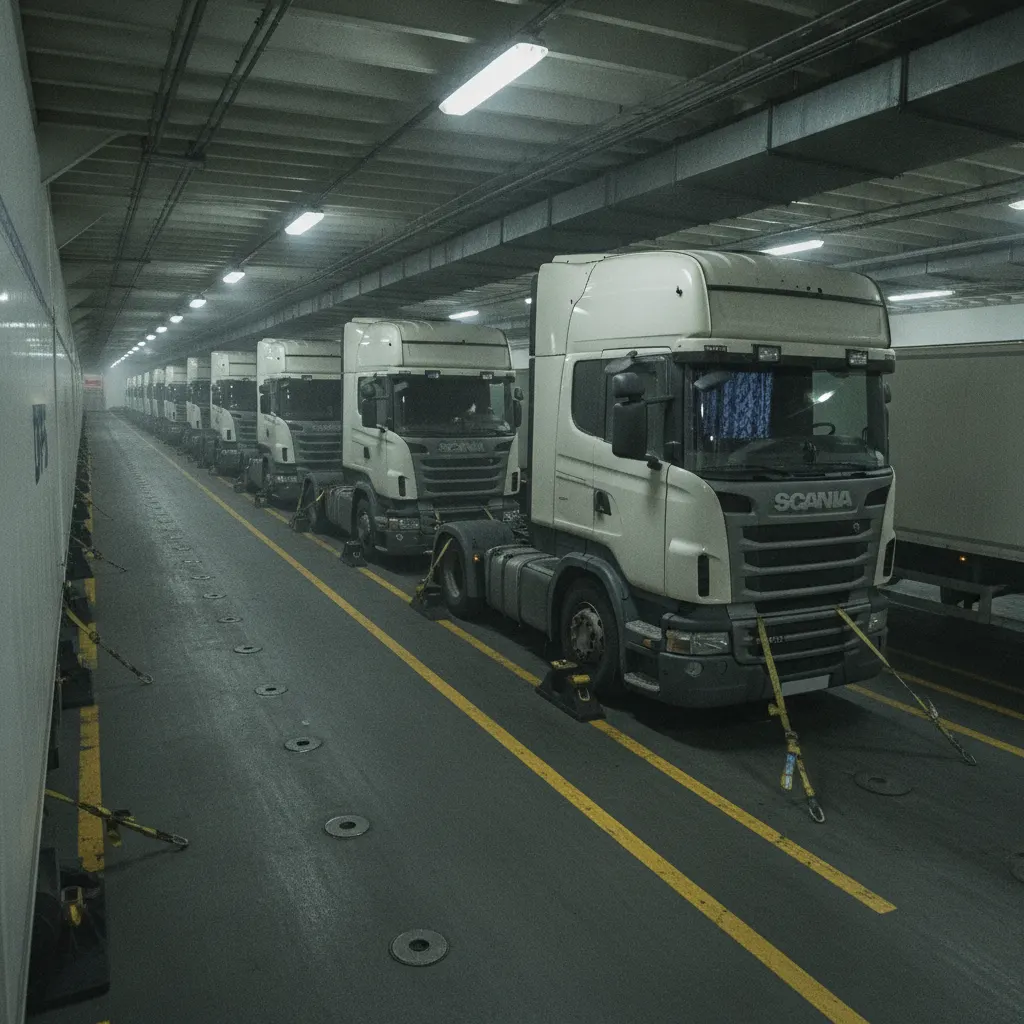
The Channel Tunnel at midnight. And a rest period I wasn't sure was still valid.
First time I drove down to Calais for a Dover-Paris contract, I left the UK terminal at 23:30 on the Eurotunnel freight shuttle. I'd started my daily rest at 22:00. My card was showing rest. The shuttle takes thirty-five minutes. I had to pull the truck forward at the French end, change lanes, get cleared by the freight marshals — about twenty minutes of activity.
Was my daily rest still valid? Had I broken it?
The answer turned out to be yes, still valid — but only because Article 9 of EU 561/2006 covers exactly this situation. And knowing the specific conditions of Article 9 matters, because if you don't meet them, the interruption breaks your rest and you need to start the clock again.
What Article 9 actually says
Article 9(1) of EU 561/2006 — the ferry and train derogation — allows a driver accompanying a vehicle on a ferry or train to take a regular daily rest period or reduced weekly rest period that is interrupted no more than twice, with other activities totalling no more than one hour in total.
Two conditions: first, the interruptions combined must not exceed one hour of activity. Second, during the rest period the driver must have access to a sleeper cabin, bunk or couchette at their disposal.
For the Channel Tunnel specifically, bunk access depends on the service. Eurotunnel freight shuttles don't have sleeper accommodation — you're in the cab. That's technically a couchette or bunk if your sleeper cab qualifies. DVSA guidance doesn't define minimum cab standards for Article 9 purposes, but a purpose-built sleeper cab with a proper bunk is the usual expectation. A day cab without a bunk is a harder argument.
The regular weekly rest condition — this is stricter
For daily rest and reduced weekly rest, the journey length doesn't matter. Any ferry or train leg works — thirty-five minutes, four hours, overnight — provided the two conditions above are met.
For a regular weekly rest — forty-five hours — the conditions are tighter. The journey must be scheduled for eight hours or more. And the driver must have access to a sleeper cabin specifically, not just any bunk or couchette. A shared couchette in a train passenger carriage isn't what the regulation has in mind.
This matters for ferry crossings. Calais to Dover takes ninety minutes — no good for a regular weekly rest interruption, because the journey is under eight hours. Calais to Dover doesn't count. Harwich to Hoek van Holland takes about seven to eight hours depending on the sailing — borderline. Hull to Rotterdam or Zeebrugge overnight crossings at fifteen or seventeen hours: those qualify, provided you have access to a cabin.
Running down to the port on a Friday night to take weekly rest on a cross-channel sailing has a certain logic to it. But the eight-hour rule applies to the scheduled journey time, not how long you happen to spend on the vessel. A delayed departure that extends a six-hour crossing to nine hours doesn't retrospectively qualify it.
The one-hour total interruption budget
Two interruptions permitted. Total activity time across both must not exceed one hour.
What counts as an interruption? Any activity other than rest. Moving the vehicle on or off the ferry. Fuel stop at the port. Customs and freight clearance. Paperwork at the border. If you have to get out of the bunk for any reason and do anything — even just shifting the truck five metres at a French port — that's an interruption.
The one-hour budget is generous for most operations. A standard drive-on ferry boarding takes ten to fifteen minutes. The drive-off at the other end takes about the same. Two interruptions, twenty to thirty minutes total — well within the limit.
Where it gets tight: multiple freight checks, a delayed berth that means moving the vehicle twice at the dock, a customs examination at the French end that takes forty-five minutes. Start stacking activities and the one-hour budget erodes quickly. If you exceed it, the rest period is broken — you need to start a new one and the hours already accumulated on the interrupted rest don't carry forward.
What counts as 'available' to you?
The regulation says the driver must have access to a sleeper cabin, bunk or couchette at their disposal. That's different from being required to use it — you don't have to be asleep for the rest period to count. But it must be genuinely available.
A sleeper cab on a freight deck where you can physically get into your bunk satisfies this. A day cab with no sleeping provision doesn't, though there's been no UK case law I'm aware of specifically ruling on the minimum standard. Being in a reclining seat in a passenger carriage isn't a bunk or couchette in the sense Article 9 envisages.
For overnight crossings in a proper sleeper cabin on a P&O or DFDS freight service — Hull to Rotterdam, Hull to Zeebrugge — the condition is clearly met. Those services specifically offer freight driver cabins. Book ahead; they sell out, especially mid-week when there's volume moving through the ports.
The two-interruption cap matters more than the hour cap on some runs
On longer crossings, you might hit two interruptions well before you get close to an hour's activity. If you've boarded at Hull, moved the vehicle once at the dock, then been asked to shift it again for another vehicle at 03:00 because of a lashing issue — that's both your interruptions used up. Any further activity after that breaks the rest.
Two interruptions is not the same as two hours of interruptions or two separate activities. Two separate interruptions — each being any period of activity, regardless of duration — is the cap. The first time you do something other than rest is interruption one. The second time is interruption two. There's no third.
A mate running cross-channel freight learned this at the hard way on a Dunkirk to Rosyth sailing after a particularly chaotic loading sequence on the French side. Moved his trailer twice pre-departure, and then had to assist with a problem on the freight deck around midnight. Three activity periods. His rest was broken. He restarted from midnight and it changed his entire delivery schedule on arrival.
What happens when you travel to the ferry on your own?
Article 9(2) covers a related situation: travel to take charge of a vehicle, or return from a location after leaving it. That travel — if you're on a ferry or train with access to a bunk or couchette — can count as rest.
If you're travelling to a vehicle that isn't at your home or operational centre — say, positioning to a port by train to collect a truck — the train journey can count as rest if you have bunk access, and as other work if you don't. If you're driving a non-EU 561 vehicle to reach the truck, that driving counts as other work regardless.
This is the sort of provision most UK drivers never encounter. But for international operators regularly positioning drivers to European depots or ports, it's worth knowing.
Does this apply to UK domestic ferry crossings?
Yes. The ferry exemption under Article 9 applies to domestic crossings as well as international ones. If you're running a trailer onto a Stena Line sailing from Holyhead to Dublin, or a Caledonian MacBrayne freight sailing to Orkney, Article 9 applies to any rest periods taken on those vessels — provided the conditions are met.
The eight-hour minimum journey requirement for regular weekly rest still applies. Holyhead to Dublin is around two to three and a half hours depending on the service. That crossing doesn't qualify for a regular weekly rest interruption. A Holyhead to Dublin crossing with a rest start and end at the terminal doesn't change that.
For the longer domestic routes — Aberdeen to Shetland, for example, which is around fourteen hours — the weekly rest condition is met. A proper ferry cabin on the overnight Northlink Ferries service satisfies the sleeper cabin requirement. Probably the most comfortable weekly rest you'll take as an HGV driver.
Article 9 doesn't extend your rest period — it just allows it to be interrupted
This matters. Article 9 doesn't give you extra rest time. It says your rest period can be interrupted without being broken. The minimum durations still apply — eleven hours for a regular daily rest, nine for a reduced one, forty-five for a regular weekly rest.
Time spent in active interruptions — moving the vehicle, clearing customs, doing paperwork — does not count towards your rest period. If your daily rest started at 22:00 and you had two interruptions totalling forty minutes, you still need eleven hours of actual rest, and the forty minutes of activity doesn't count. Your rest period effectively lasts eleven hours forty minutes total.
For planning purposes on an overnight crossing, that means starting your rest with enough buffer to account for the interruptions you know will happen — boarding and disembarkation activities — plus the minimum rest duration you need.
Getting these rules right isn't just about passing a roadside check. It's about knowing you've actually rested legally, that your card accurately reflects a valid period, and that when DVSA look at the analysis your records are clean. If you're tracking ferry runs manually and trying to remember whether the Article 9 conditions were met each time, ShiftOwt tracks compliance automatically — £5.99/mo for drivers, agency pricing on request.