
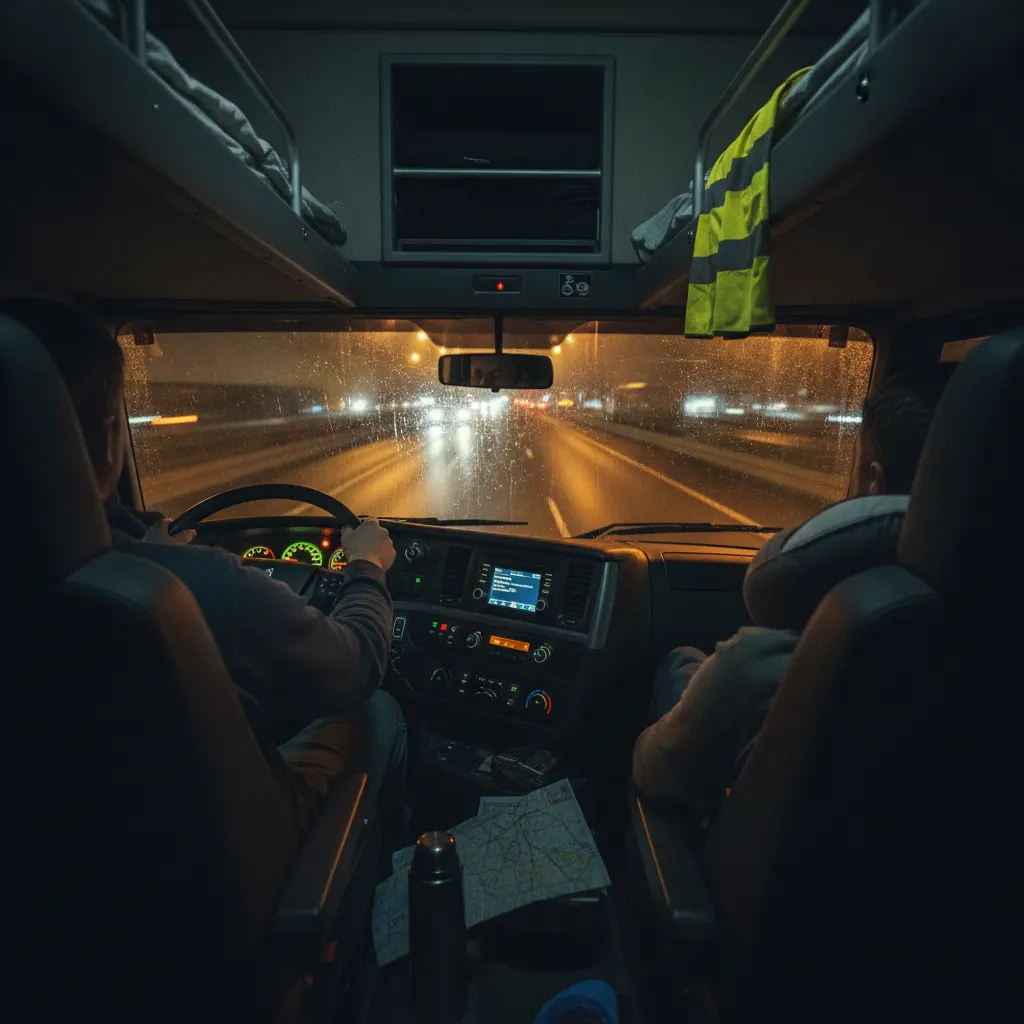
Double-manned. Two drivers, one truck, and a set of rules most people only half-know.
I started doing double-manned runs in my third year on the road. Glasgow to Immingham, 06:00 start, swap at the A1 services near Newark. Good rate, quieter roads at night. And for a year or so, I ran them without properly understanding how the hours rules worked differently from a solo run.
Nobody at the briefing mentioned the 30-hour window. Or the availability switch. The TM just said 'you're double-manned, you can drive more' and left it there. That's technically true, but it's not the whole picture.
What multi-manning actually means under Article 4
Multi-manning under EU 561/2006 is defined in Article 4(o). Two drivers in the vehicle, sharing the driving, for each period between consecutive rest periods. There's a wrinkle: during the first hour of the period, having the second driver on board is optional. After that, it's compulsory. So a double-manned run where the second driver doesn't join until ninety minutes in has been single-manned for the first hour and a half — which has implications for how the records read.
In practice on most operations, both drivers are on from the start. If you're collecting a second driver at a motorway services sixty miles from the depot, the clock on that first sixty miles is still running as single-manning from the vehicle unit's perspective. Worth being aware of if you're ever asked to explain a record.
The 30-hour window — this is the bit that changes everything
Under Article 8(5) of EU 561/2006, a driver on a multi-manned run must take a new daily rest of at least nine consecutive hours within thirty hours of the end of the previous daily or weekly rest.
Single-manning: nine hours of daily rest required within twenty-four hours. That's the standard rule.
Multi-manning: nine hours within thirty hours. You've got an extra six hours to fit the rest in.
That's what allows the extended runs. A two-man crew can collectively cover the vehicle for up to twenty hours — if both use their full ten-hour driving extension for that day. In practice most runs are shorter, but the extended window is what makes the economics of long-distance double-manned work viable.
The nine-hour minimum is the same figure as a reduced daily rest for a solo driver. But for multi-manning, it's the standard expectation — no compensation required, no limit on how often you use it. It's just the normal rest for a double-manned shift, within thirty hours.
The availability switch — your most useful tool
Here's something that took me a while to properly use. When you're the co-driver — sitting in the cab while the other driver's at the wheel, not driving, not doing any work — that time goes on availability on your tachograph. Not rest. Not other work. Availability.
Availability doesn't count as working time under the WTD, so it doesn't push you towards the break trigger. And crucially, a block of availability time can function as part of your break calculation under EU 561.
Article 7 was amended — as part of Mobility Package I — to specifically allow a driver on a multi-manned run to take their forty-five-minute break in the vehicle while the other driver drives, provided you're not involved in assisting the driving. Not touching controls. Not reading maps or talking the other driver through a complex route. Off-duty in the passenger seat.
So if you've been driving and then swap, and you sit in the passenger seat for forty-five minutes doing nothing, that's your break. You don't need to stop the vehicle. The run continues. This is the core efficiency gain of double-manned operations — the vehicle keeps moving while breaks are being taken.
What the co-driver's record should show
Your tachograph card records your activity. When you're the co-driver not driving, that time should typically show as availability — mode 3, the bed icon — unless you're actually doing other work (navigating, handling paperwork, assisting). Driving shows on your card when you're driving, availability when you're a passenger, rest only when the vehicle's stopped and you're in your bunk or genuinely off-duty.
I've seen printouts from double-manned runs where the co-driver showed the entire non-driving period as rest. That's not usually correct — rest under EU 561 requires the driver to be able to freely use their time, and being a passenger in a moving vehicle with potential duties doesn't necessarily qualify. DVSA might question it at a roadside check.
Availability is usually the right mode for the co-driving period. It doesn't penalise you — it doesn't count as driving time, it doesn't accumulate as working time, and it can count towards your break if you're genuinely not involved in assisting.
How the daily driving limits stack up on a two-man run
Each driver's personal driving time limits still apply. You still can't drive more than nine hours individually — or ten if you're using your extension. The vehicle can be driven for longer because the two drivers take turns, but neither of you accumulates the other's driving hours.
A two-man crew running at maximum — both using their ten-hour extension — can cover up to twenty hours of driving before the vehicle needs to stop for the night. In real operations that's unusual. Most double-manned runs are structured around a swap point roughly in the middle of the intended route, with both drivers comfortable within their daily limits by the time they reach a rest location.
The 56-hour weekly driving limit still applies to each driver individually. The fortnightly 90-hour cap still applies. Double-manning the vehicle doesn't extend your personal driving limits beyond what EU 561 allows — it only changes the window in which you need to take your rest.
Rest options within the 30-hour window
Within the 30-hour multi-manning window, you can take the nine-hour block any way that works with the run. It doesn't have to be at the end of the driving day — though in practice it usually is.
The 3+9 split daily rest is also available. Article 4(g) of EU 561/2006 defines a regular daily rest as either eleven consecutive hours, or two periods where the first is at least three hours and the second is at least nine hours. The split produces twelve hours total but in two parts. For multi-manning it's less commonly used than the straight nine-hour block within thirty hours, but it's available if the run structure makes it useful.
If your rest exceeds eleven hours straight, it becomes a regular daily rest rather than a reduced one. That's fine — it's just more rest. Nothing prohibits it. But the distinction matters for record analysis, because a regular daily rest resets the reduced rest count in a different way than a reduced one does.
The regular weekly rest rule still applies
Multi-manning changes the daily rest window. It doesn't change the weekly rest obligations.
You still need to start a weekly rest before the end of six consecutive twenty-four-hour periods after your last weekly rest. A double-manned run with extended driving days makes it easy to lose count. If you're doing multi-manned nights out of Carlisle on a Monday and rolling all week, the sixth-period deadline still applies. By the end of Saturday — or sooner, depending on exactly when your last weekly rest ended — your weekly rest must have started.
A reduced weekly rest is at least twenty-four hours, and there are conditions on how often you can use them. Two consecutive reduced weekly rests in a row are only allowed under specific international transport conditions. In standard UK operation, one in two consecutive weeks.
And a reduced weekly rest needs compensating. The compensation — a rest equivalent to the reduction — must be attached to another rest of at least nine hours, and it must be taken before the end of the third week following the week when you took the reduction. I've covered the compensation rules in more detail in this post.
A common misconception about multi-manning and weekly rest
A driver I worked with at Stafford thought double-manned runs meant both drivers could take their weekly rest in the vehicle — curled up in the bunk in the cab park while the other driver was off somewhere else. That's wrong.
Regular weekly rests — forty-five hours — cannot be taken in a vehicle. Full stop. That applies equally to single-manned and multi-manned operations. The employer is obliged to arrange suitable accommodation with proper sleeping and sanitary facilities, and to pay for it.
Taking a forty-five-hour weekly rest in the sleeper cab is a breach of EU 561/2006, regardless of how convenient the cab park is or how comfortable the bunk. DVSA have been clearer on this since Mobility Package I came in. The vehicle accommodation prohibition is firm.
Practical notes
If you're doing double-manned runs and neither driver is clear on the 30-hour window, the availability switch, or how the driving limits stack individually, you're operating on incomplete information. The rules aren't complicated once you understand them, but the default briefing most drivers get — 'you can drive more in a double-manned vehicle' — leaves out everything that actually matters for compliance.
Check your availability mode is set correctly when you're the passenger. Take your breaks in the vehicle when you're not assisting the other driver. Keep your personal driving totals to your own limits. And know where your 30-hour rest window ends — the deadline is tighter than it might seem on a long run.
If you're tracking multi-manned hours alongside solo shifts and trying to keep the 30-hour window in your head manually, ShiftOwt tracks EU 561 compliance automatically — £5.99/mo for drivers, agency pricing on request.