
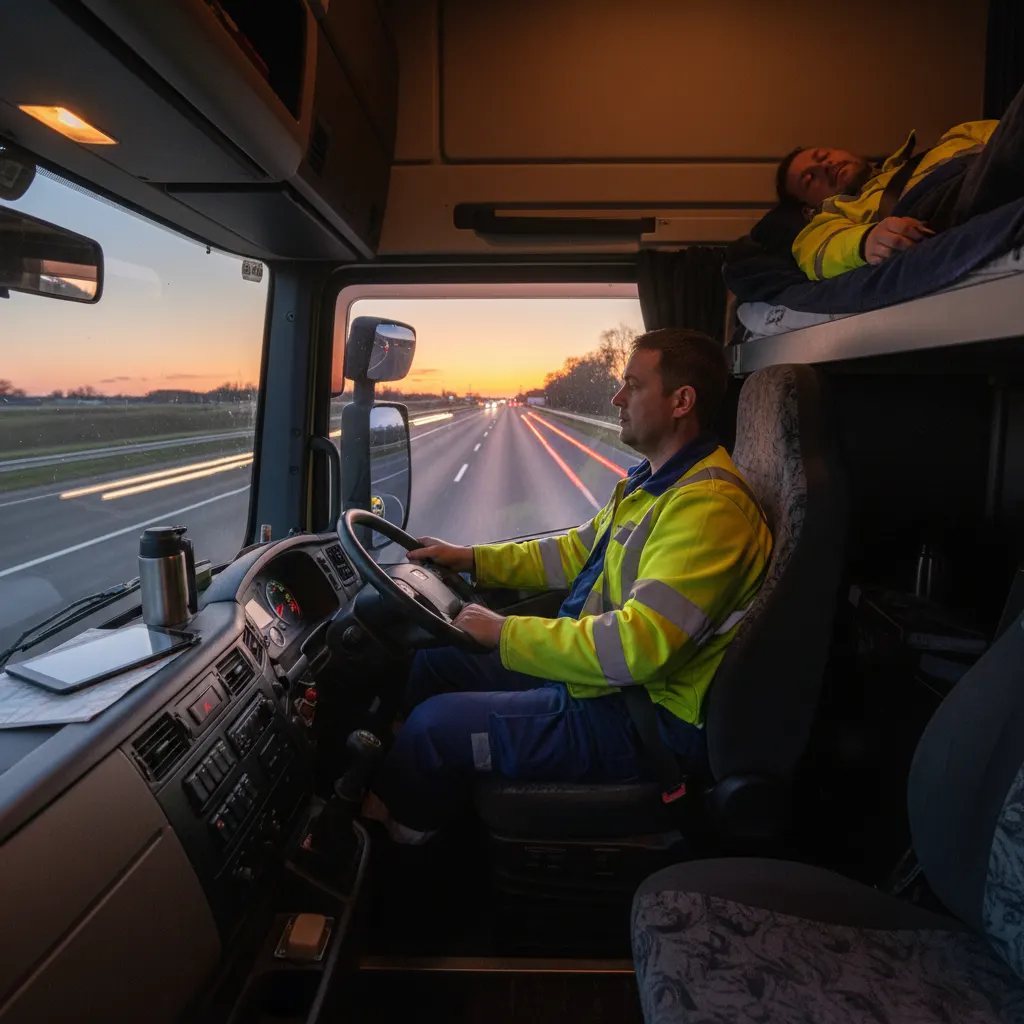
Double-manning is a useful tool. Two drivers, one vehicle, and the clock that says "9-hour daily rest within every 24 hours" gets extended to "9-hour daily rest within every 30 hours." On paper, the two of you can keep a vehicle moving for 21 hours out of 30. In practice, lots of operators do exactly that on long Continental runs or on time-critical UK work — Dover to Carlisle in one go, Immingham to Holyhead overnight, that kind of thing.
The rules sit in Article 4 and Article 8 of Regulation 561/2006 (still in force in the UK under the assimilated drivers' hours rules). They're not especially complicated. But they have some edges that catch drivers out, and I've watched a few mates pick up graduated fixed penalties because they got the timing wrong.
Let me walk through how it actually works.
What "multi-manning" legally means
A multi-manned or double-manned operation is one where, for the majority of the driving period between two consecutive daily rest periods, there are at least two drivers in the vehicle to do the driving.
The key words there are "the majority of the driving period." Not the whole period. Not every minute of the shift. The majority.
Which brings us to the first-hour rule, which is the bit everyone gets wrong.
The first-hour exception — and its limits
For the first hour of the duty, the second driver does not need to be on board. This is so you can pick up your co-driver en route — common on Continental runs where one driver might bring the vehicle out of the yard and collect the other at a meet-up point at a service station.
After that first hour, the two drivers must be together in the vehicle for the rest of the shift if you want the whole shift to count as multi-manned.
Easy to say. The trap: if your co-driver is delayed and doesn't make it into the cab within the first hour, your shift is not multi-manned. The 24-hour rest clock applies instead of the 30-hour one. And if you've already planned the shift around a 30-hour window — which is why you were multi-manning in the first place — you're now in infringement territory the moment you pass 13 hours of duty time.
I watched this happen to a mate running flat-deck out of Rugby. Plan was: pick up vehicle at DIRFT, drive 50 minutes to the driver-change point at Corley Services, pick up the second driver, go. Second driver's car wouldn't start at home. He was 90 minutes late to the rendezvous.
First driver made the wrong call. Rather than take a daily rest and try again the next day, he waited at Corley with the mode on other work, assuming the clock "paused." It doesn't pause. The 24-hour clock applied because the second driver was outside the first hour.
Eighteen hours later, they got pulled on the M1 northbound. Tacho analyser at the roadside showed the second driver had boarded at hour 2.5 of the shift. Not multi-manned. £200 fixed penalty each for a daily rest infringement they hadn't realised they were committing.
If your co-driver is going to be more than an hour late, stop. Take rest. Restart the shift plan. That's the only safe response.
The 9-hour rest within 30 hours
The core derogation under Article 8 is this: on a multi-manned operation, each driver must take a daily rest of at least 9 hours within 30 hours of the end of the previous daily or weekly rest.
Compare with a solo driver, who must take the same 9-hour minimum daily rest within 24 hours of the end of the previous rest.
That's the six extra hours that make multi-manning attractive. But note: the rest is still 9 hours minimum, not less. You haven't saved rest time. You've just extended the window within which it has to fall.
Both drivers need to take that 9-hour rest. Both clocks run in parallel. If driver A starts the shift at 06:00, their 30-hour window runs to 12:00 the following day. If driver B boards at 07:00 (within the first-hour exception), driver B's 30-hour window runs from when they last took a daily rest themselves — which, if they were at home the previous night, would have started when they finished their last shift, not when they boarded today's.
This matters. Drivers who think "my clock starts when I board" are wrong. Your clock starts from the end of your last daily rest, whenever that was.
The second driver's tacho — period of availability vs other work
The single biggest source of fiddly tacho confusion I see on multi-manning is how the second driver records their time when the first driver is at the wheel.
For the driver who isn't driving, their time in the moving vehicle counts as period of availability (POA) under WTD, not working time. On the tacho head, they select the POA symbol (square/envelope icon). Their driver card is in the slot 2 position, and the tacho records their activity separately from the driver at the wheel.
POA does not count as a break under 561. That's a common mistake. Sitting in the passenger seat as the vehicle rolls is not a break — it's POA, which is neither work nor rest nor break. You can accumulate POA for hours and your 561 break clock keeps ticking on any driving you did before the swap.
If you want the rest period to count under 561, you need to actually rest — usually in the bunk, not in the passenger seat. Both drivers taking rest at the same time on a moving vehicle doesn't work, obviously, because there's nobody driving. So rest periods have to be staged between the swap points.
Rest in a moving vehicle — the bunk rule
Under Article 8 of 561/2006, daily rest can be taken in the vehicle if the vehicle is equipped with suitable sleeping facilities and is stationary. Key words: stationary.
You cannot take a daily rest period in the bunk while the vehicle is moving. The tacho will flag it. DVSA analysers will flag it. This is true for solo drivers — and it's true for the non-driving driver on a multi-manned shift.
So when you swap over, the driver who's just come off the wheel is on POA (if they're staying in the moving cab) until the vehicle stops for a genuine rest period. Then they can take their 9-hour rest proper. Then they swap back.
On a well-run double-man, the cycle is usually something like: Driver A drives 4.5 hours, takes 45 minutes break, drives another couple of hours. Driver B takes over, drives a shift. Driver A takes their 9-hour rest during B's driving time (if there's a stationary period built in). Then A takes over, and B rests. In practice, this almost always requires one or two stationary periods to make the rest legal.
Operators who design double-man schedules that assume rest-in-motion are setting their drivers up for infringements. I've seen it on a couple of job adverts and walked away from both.
Weekly rest and multi-manning
The weekly rest rules are identical for multi-manning as for solo driving. 45 hours regular, 24 hours reduced, and over any 4-week period at least 2 of the weekly rests must be regular (45 hours). Any reduced weekly rest must be compensated by an equivalent block of rest attached to another rest period of at least 9 hours, taken before the end of the third week following the reduction.
Multi-manning doesn't get you anything extra on the weekly rest side. The derogation is purely about the daily rest window.
Continental runs — the common pattern
The classic UK-to-Continental double-man looks like this:
- Driver A collects vehicle at the yard. 50 minutes to the ferry collection point, where driver B is waiting.
- Driver A drives onto the ferry. Both drivers take a rest period in a cabin (ferry derogation applies — Article 9).
- Off the ferry at Calais or Dunkerque. Driver B takes the wheel.
- Driver B drives to a change point. Swap. Driver A drives.
- End of shift — both drivers take a 9-hour rest at a secure park in France.
The tacho records for this pattern are complex. Each driver's card logs their activity — driving, POA, rest — separately. Both cards are in the vehicle unit simultaneously. Both cards are subject to download and analysis.
If you're running this kind of pattern, the operator's analyser has to be set up for multi-manning. Most modern analysers handle it fine — but it requires the TM to tag the duty as multi-manned and to check the joint records against each other. Mismatches between the two drivers' activity records are where Continental-running fleets tend to pick up infringements.
The Mobility Package I bit
For international work — Great Britain to mainland Europe — the Mobility Package I rules introduced in 2020 added some provisions. The one that matters most for drivers is the requirement to return to base (home country) at least every 4 weeks. The driver can't spend 4 consecutive weeks away from home without a proper return.
This affects double-manned long-distance Continental work. If you're tramping in Europe with a co-driver for weeks at a time, you both need to rotate back to the UK at least every 4 weeks. The operator has to provide the return.
There's also the international weekly rest rule under Mobility Package I — regular weekly rests of 45 hours cannot be taken in the vehicle; they must be taken at home or in suitable gender-friendly accommodation with proper sleeping and sanitary facilities. The operator has to cover the cost. This is a big change from the pre-2018 period when some Continental operators were parking drivers in laybys for days at a stretch.
What DVSA looks at on a multi-manned download
When a double-manned vehicle gets pulled and the vehicle unit is downloaded, DVSA looks at three things:
- Was the vehicle moving with both drivers' cards in the slots? If one card is in and the vehicle is moving, they'll question whether the duty was actually multi-manned or solo-with-passenger.
- Are the rest periods plausible? 9 hours of rest in a moving vehicle is not plausible. The vehicle unit records when the wheels turn.
- Are the duty periods within the 30-hour window? Both drivers, separately, must have taken their 9-hour rest within the 30-hour window from their own previous rest.
Any of these flagging up triggers a fuller investigation. The fuller investigation often finds related issues — card manipulation, badly-recorded manual entries, POA used in place of rest. One downloaded infringement tends to find three.
When multi-manning isn't worth it
Not every long run benefits from double-manning. If the math works out to 18 hours of total duty, and solo operations can do that with a daily rest in the middle, multi-manning adds cost (two drivers) for not much gain.
Multi-manning shines on:
- Continental long-distance with ferry involved
- Time-critical UK runs where the 24-hour window would force a spare vehicle or a layover
- High-value loads where security requires two drivers anyway
It struggles on:
- Short UK domestic work (doesn't save much)
- Drivers who aren't well-matched in pace or preferences (the cab gets small)
- Schedules that assume rest-in-motion (not legal)
The checklist for drivers doing their first double-man
- Know your own clock. Your 30-hour window starts at the end of your last daily rest, not when you board the cab.
- First hour only — after that, both drivers must be present.
- Swap the tacho mode properly at each handover. The driver at the wheel is on driving automatically; the off-driver selects POA or rest, not other work.
- Rest is rest, POA is not rest. Taking POA for 9 hours while the vehicle moves is not a daily rest.
- Stop for the proper daily rest period. The bunk is legal for rest; it's just not legal while the wheels are turning.
Honest CTA
Running double-manned schedules needs both drivers' clocks tracked in parallel against their individual rest windows. ShiftOwt handles multi-manning clocks alongside your solo compliance — £5.99/mo for drivers, agency pricing on request. If you're running Continental and you're tired of working out two drivers' 30-hour windows on a bit of scrap paper, this is the use case I built it for first.