
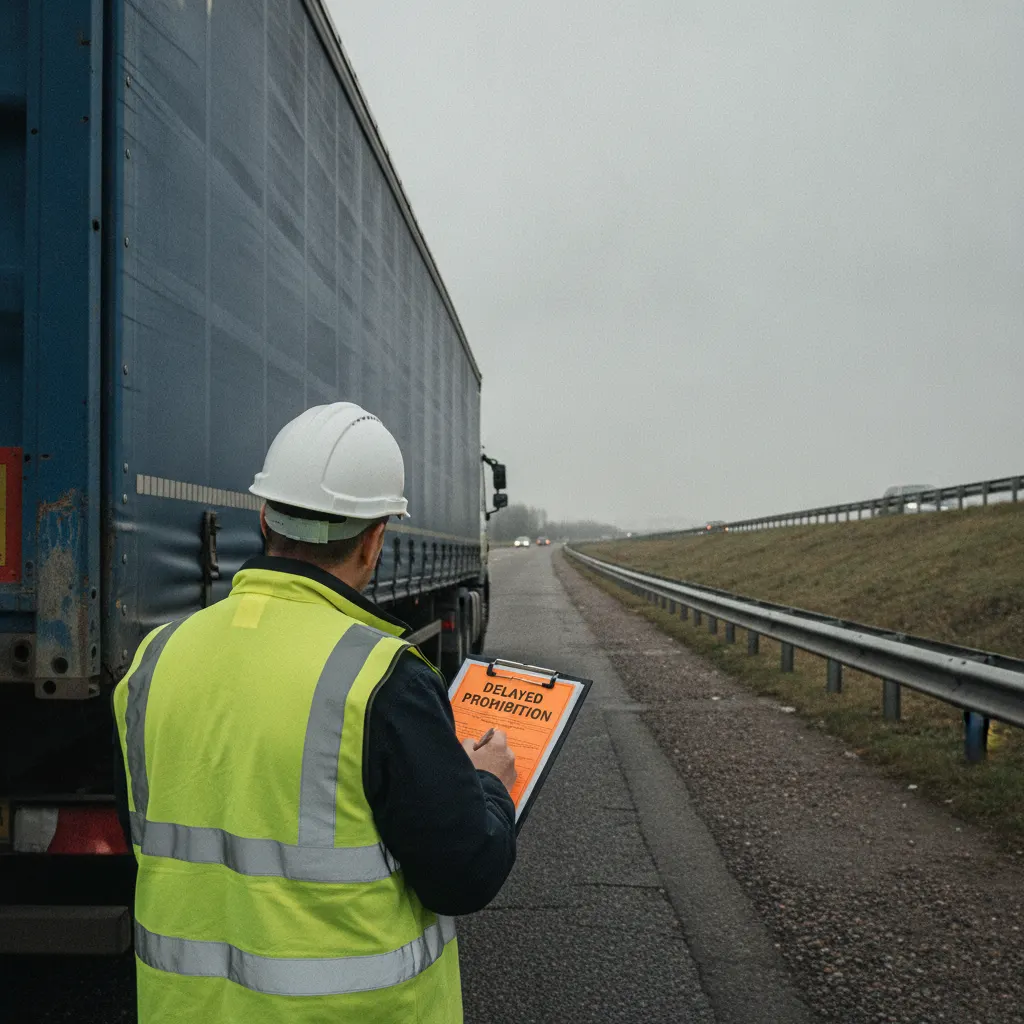
Most drivers know what a PG9 is. Vehicle's off the road, full stop, don't move it until it's fixed and cleared. PG10 is less talked about but it catches fleets out in a different way. The vehicle can technically keep running — for now. But the clock's already started.
I picked up a PG10 on a unit running out of Immingham about three years ago. Nearside rear glad-hand had a slow weep — not a catastrophic air loss, nothing that was going to kill anyone on the A180, but enough that a DVSA examiner at a weigh bridge check clocked it and issued a delayed prohibition. The vehicle carried on to the delivery, came back to the yard, and went in for repair. But the OCRS hit was already logged. That was my introduction to how much quieter PG10s are on paper and how much noise they make on a compliance record.
What the categories actually mean
DVSA uses three notice types when they find defects at a roadside inspection or a vehicle examination. Understanding which one you're getting is important because the consequences are different.
An immediate prohibition means the vehicle cannot be driven on a public road until the defect is rectified and the notice is formally removed. The examiner decides on the spot whether the defect puts people at risk right now. Brake failure, steering defects, a wheel about to come off — that's an immediate prohibition. The vehicle stays where it is.
A delayed prohibition is issued when the defect is real and recordable but doesn't present an immediate danger. The vehicle can continue operating until the time period stated on the notice — the examiner sets the deadline based on the defect and the risk it presents. At the end of that period, the defect must be fixed. If it isn't, the delayed prohibition converts — you're now running an unroadworthy vehicle on a live prohibition, which is a different level of offence entirely.
An advisory or inspection notice means the examiner identified something worth flagging but decided it doesn't warrant a prohibition right now. No ban — immediate or delayed — but it's on record, and it will come up at your next check.
What triggers a delayed rather than immediate prohibition
The judgment call is made by the examiner. They're working from DVSA's categorisation guidance, which maps defect types to categories — dangerous (immediate risk to life), major (significant risk but not immediate), minor (doesn't meet the threshold for prohibition). The broad principle is that dangerous defects get immediate prohibitions and major defects may get delayed ones, though the examiner has discretion based on the specific circumstances.
Common delayed prohibition triggers include: tyre tread that's below the 1mm legal minimum but not at zero; worn brake linings that haven't failed yet; lighting defects; minor bodywork or securing issues. Nothing catastrophic, but things that need sorting. The examiner is making a professional judgment about how quickly the risk materialises.
The specific period given on a delayed prohibition isn't fixed by statute — it's set by the examiner and shown on the notice itself. Read the notice carefully. The date and time are on there. That's your deadline, not an estimate.
Getting the prohibition lifted
Once the defect is repaired, you need the prohibition formally removed. For DVSA-issued prohibitions, that generally means a follow-up inspection — either a DVSA-attended clearance at a testing station or a full MOT, depending on the nature of the defect and what the notice specifies. The vehicle must pass before the prohibition is lifted. Don't assume that because the repair was done, the prohibition automatically clears.
Some operators make the mistake of getting the vehicle fixed and putting it back on the road without formally clearing the notice. The physical defect might be gone, but the prohibition is still live on DVSA's systems. If the vehicle gets pulled again before it's been cleared, the driver and operator are in serious trouble.
Contact your nearest DVSA testing station as soon as the repair's done. Have the paperwork ready. They'll book the inspection and issue formal clearance once the vehicle passes. Keep the paperwork — DVSA's records update, but there can be delays, and having the physical clearance document is your proof if there's a query later.
The OCRS calculation
Here's the part that stings. When DVSA issues a prohibition — immediate or delayed — it's recorded against the operator licence. That recording feeds into the Operator Compliance Risk Score. The score is a rolling calculation that influences how likely DVSA is to target you for future checks. It covers roadworthiness and traffic offences across your fleet, weighted by severity.
A delayed prohibition is less severe than an immediate one in the hierarchy, but it still goes in. And it stays in. The OCRS is based on your enforcement history over a defined period — it's not reset when you clear the prohibition. The fact that you got the vehicle fixed on time, that the delay was within the specified window, that it was a minor defect — none of that removes the record of the prohibition being issued. You carry that.
Fleets that run amber or red on OCRS get checked more often. More checks means more findings. For an operator running 12 vehicles out of a yard near Coventry, one PG10 isn't a disaster. Three in a quarter — one per vehicle on average — and you're likely to see an increase in roadside attention. The pattern matters as much as the individual incidents.
Preventing them in the first place
The obvious answer is the walkaround check and the preventive maintenance inspection. DVSA's guidance is clear that operators are responsible for keeping vehicles in roadworthy condition at all times — not just at the annual test. A six-weekly PMI schedule, a properly completed defect report each day, and a system for tracking reported defects through to repair completion are the operational minimum.
The defect report bit is where I've seen small operators fall down more than anywhere else. Drivers report defects verbally. Nothing goes on paper. Defect never gets properly recorded or signed off. Then DVSA pull the vehicle, find a defect the driver had been reporting for a week, and the operator has no record of any of it. That's worse than having a defect — you've now got a defect and evidence that your monitoring system doesn't work.
If you're managing a fleet and trying to keep track of vehicle condition, defect reporting, and download schedules in one place, ShiftOwt handles the compliance side automatically — £5.99/mo for drivers, operator and agency pricing available on request.
One more thing on the notice itself
Drivers sometimes treat a PG10 as someone else's problem — it's the operator's vehicle, the operator's licence, the operator's OCRS hit. That's true up to a point. But if a driver continues to use a vehicle after a delayed prohibition has expired without the defect being cleared, they're driving on a live prohibition. That's a driver offence, not just an operator one. The notice is issued to the operator, but the driver can be prosecuted for ignoring it.
Read it. Date it. Hand it to your operator with your name on it. Don't assume it's been dealt with until you've seen the clearance paperwork.